
The forest plants that live on Earth are suited to the characteristics of each region. Trees that live in the forest lose their leaves before the cold season to protect their lives. (See blog 215) When leaves fall to the ground, they accumulate and absorb water from rain and other sources. The piled-up leaves become hot as fungi grow and ferment. The leaves piled up in layers rot due to the power of fungi and eventually turn into leaf mold (see blog 212). Under the leaf mold, there is humus that has been formed over time. Various types of fungi grow in the leaf mold, which further promotes the decomposition of plant fibers and turns it into soil. In the nutrient-rich soil thus created, organisms such as earthworms begin to live. Earthworms eat decaying matter in the soil and purify the soil. In addition, holes are created along the path that the earthworms travel, which have the advantage of supplying oxygen to the soil and storing water. The fungi in the leaf mold extend their hyphae and spread throughout the soil. Mushrooms produced by the fungi appear above the ground. Mushrooms form caps and gill and use water droplets that adhere to the surface of the spores formed on the gills to disperse spores far away, allowing fungi to spread widely and continue to survive.
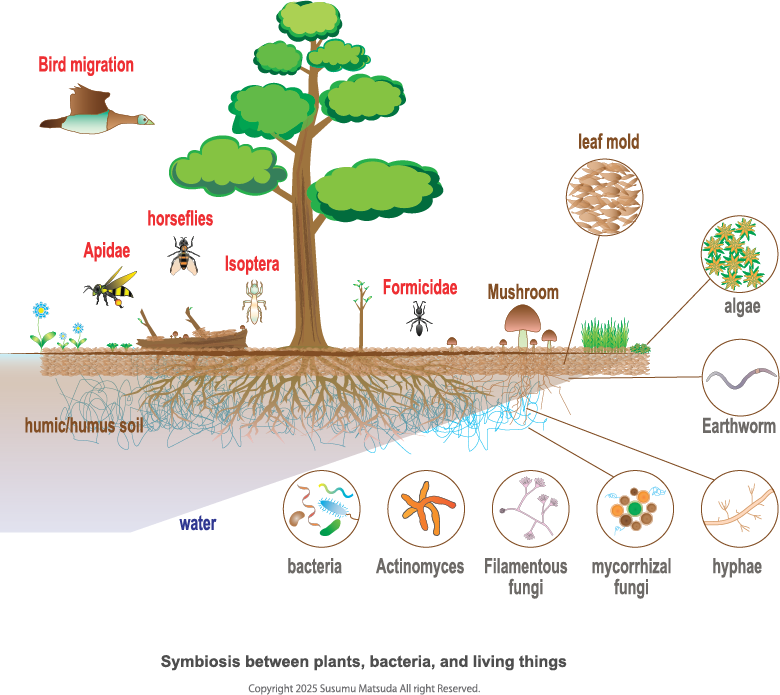
Trees that live in the forest fall after they have completed their role. The fibers of fallen trees are broken down by fungi and eventually turn into forest soil. In this way, migratory birds and insects that travel long distances (hors flies are also known to travel long distances: see blog208) fly into the forest. Nutrient-rich forests are home to many insects that live there. Termites are also one of the insects that live in the forest. Termites are a typical insect that people dislike because they eat wood, reduce the strength of structures, and destroy wooden houses, but they also play a role in decomposing fallen and weakened trees in the forest. In addition, the countless tunnels that termites make in the trees absorb water from rain and other sources, helping the forest to store water.(See blog 209) In this way, forests are important environments where living things coexist, but the current situation is that they are changing due to human hands. After using trees for lumber, people dislike planting broadleaf trees and plant coniferous trees. This is done by stopping the natural trees that were suitable for the selected environment and transplanting coniferous trees from other areas in order to make it easier to saw lumber after a few years. Even when coniferous trees lose their leaves, they are difficult to decompose by bacteria, and the amount of leaf mold decreases. The mycorrhizae that live in the leaf mold also decrease. Furthermore, work with heavy machinery hardens the soil. This changes the soil into a compressed soil with low oxygen, and it becomes unable to store water. This causes plant roots to grow only on the surface, and the roots cannot penetrate the hard soil, changing the environment into one prone to landslides caused by water.